discover the hidden side of sports
We redefine how player movement in sports is modeled – not as statistical expectation, but as physical certainty.
We don’t just track where a player is – We know accurately where they can be.
We have developed the first fully functional player movement engine that behaves like a real player on the field.
It creates a digital twin of every player, incorporating reaction time, acceleration behavior and physiological constraints to calculate reachable space at any given moment.
▶️ Video: Let’s see how brilliant Toni Kroos is (Coming soon)
Instead of predicting what is likely to happen, the engine computes what is physically and physiological achievable in the next phase of play. The results are deterministic and visually verifiable down to the last detail. It represents a shift from descriptive analytics to physically grounded intelligence.
We are pushing the boundaries of current Probabilistic Models
▶️ Video: Show pass areas and route visualization (Coming soon)
We know which route a player takes to receive a pass and how long it takes him and other players. And we show you these routes. Taking into account all the characteristics of the players and all the relevant circumstances of the moment.
By doing this for all possible passes, we know everything about that moment in the game. Based on the position data, we measure the game structure using tens of thousands of player's actions at once.
In doing so, we have put an end to the statistical noise and fog in game analytics.
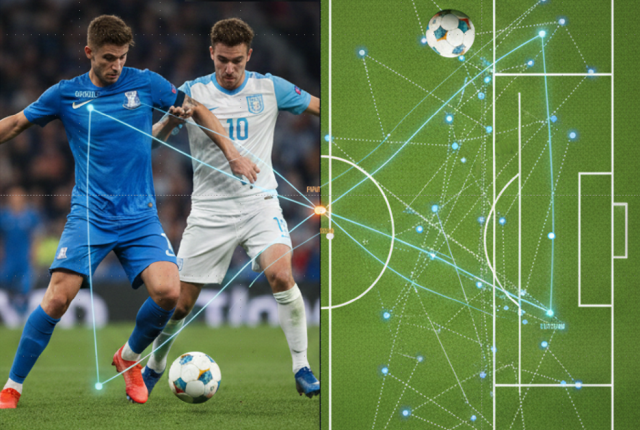
The free space for all possible ball passes is marked with centimetre precision by boundaries.
Every pass played can be quantified to see how difficult, risky and profitable it was. See who gets it first, when, where and why.
The stress level of a player at any given moment becomes quantifiable. Spatial dominance can be measured.
Built on this foundation, a new layer of sports intelligence becomes possible:
The analysis is carried out using simulation
Put simply: Our software makes it possible to play football on a computer.
In order to simulate football, the movements of the ball and players must be modelled in a Movement Model.
Our Core competence is the accurate, consistent and comprehensive representation of the football match in a mathematical and physical Movement Model, so that football sequences can be simulated.
Using this approach, our product delivers groundbreaking results.
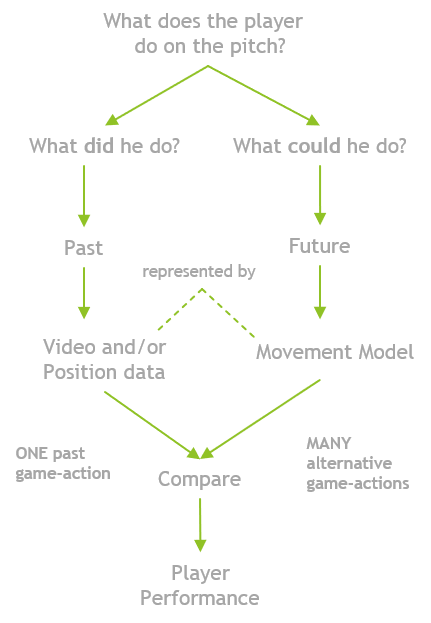
A video can't show alternative storylines, but we can!
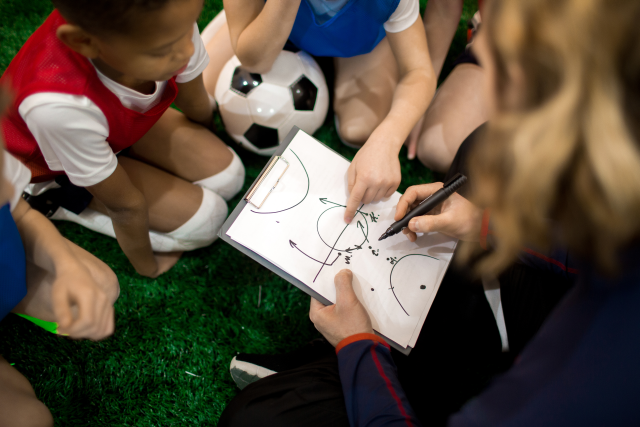
Imagine a video session with the player, just as is done in all professional clubs.
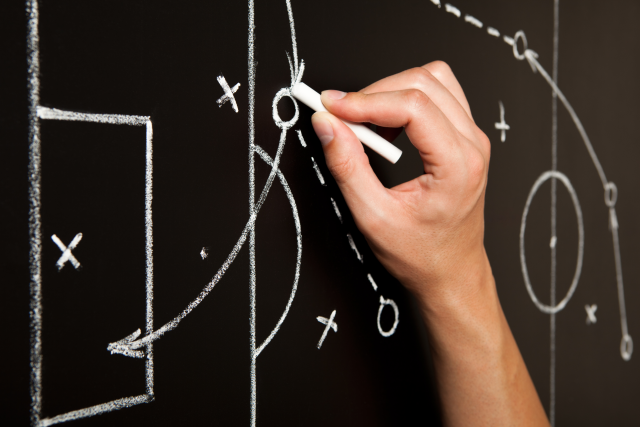
The video is paused at relevant points and an attempt is made to explain to the player what could have been done in that situation. The player’s options for action must be verbally outlined by the coach and imagined by the player in all their complexity, and all participants ask themselves: Would the action have been possible at all?
Video recordings merely depict past events. They do not allow for the consideration of alternative courses of action, nor do they permit ‘what if’ scenarios. A glimpse into potential future game developments remains denied.
Video analysis is therefore clearly limited in its possibilities: Many very important aspects of a game situation remain unclear to the player.
The accurate, realistic representation of alternative sequences involving the ball, teammates and opponents in a single sequence has not been possible until now.
Our software can do exactly that!
Using simulation, we deliver qualitative key performance indicators (KPIs) that could not previously be determined!
It makes sense to divide the KPIs into two categories:
1.) Overcoming resistance: How difficult was the situation for the player, and were they able to solve it?
We offer two new KPIs that describe in great detail just how significant the hurdles are for the player in a given situation. We are not currently aware of any other KPIs in this category.
2.) Achieving a win: Was the player able to positively influence the game structure through their action?
We can also add a new KPI to this category, as well as significantly improve an existing KPI.
All in all, this now makes it possible to measure a player’s performance on the ball! A performance analysis based exclusively on positional data, eliminating any subjectivity.
We meet the highest quality standards.
Would you like to show
A dream comes true.
Players can be shown what the ideal solution would have looked like and what is expected in similar situations.
There is no longer any need to speculate as to whether a particular action was actually possible for the player. Our simulation provides clear proof.
In this regard, we offer ultimate transparency and objectivity. This strengthens confidence in the coach’s statements and instructions.
After all, everyone involved wants one thing: a better – and therefore more valuable – player.
With a single click of the mouse, a map with ‘safe zones’ are displayed, into which the player with the ball can ‘move’.
We can show that there is no risk of a tackle in these areas, even when opponents with the acceleration of a world-class sprinters and/or have a very short reaction time.
Conversely, we can show areas where a tackle is inevitable arise.
The values for the players’ acceleration and reaction time can either be pre-set or individually adjusted.
Would you like to know
Our simulation allows us to carry out all the moves that real players on the pitch might also carry out.
Through a complex simulation experiment involving the passer, teammates and opponents, we can therefore also determine which passes are successful and which are not. We do it in exactly the same way as real players would on the pitch.
To analyse a specific game situation in this way, an average of around 20,000 runs by all players to the various positions is required. The result is unique in its informative-value and level of detail.
After the pass analysis, we know a great deal about the pass:
From all this information, it can be determined how challenging it was for the player to play this pass.
We use the simulation to capture the player's surroundings
In other words: For all the player’s options, the system checks whether executing them will lead to success. If all options end with the opponent gaining control of the ball, then the player was under immense pressure.
Such an in-depth examination of the individual play context can only be achieved through simulation and highlights the power of our tool.
In all this, we also take into account the time lag between the actor and the reacting teammates and opponents. Only in this way do the results accurately reflect the actual circumstances and correctly depict potential football scenarios.
We can break down ALL game situations in this way, even if they may seem very complex.
Every touch of the ball in football is always aimed exclusively at these two objectives:
For point 1., every player on the ball must ALWAYS find a solution for this. Either by dribbling the ball themselves or by passing it correctly to a teammate. So far, no other system apart from ours has been able to answer the crucial question: in which positions and areas is the ball not lost to the opposition?
This is precisely where top players base their excellence: they identify these positions and spaces better and faster. Because they are aware of the importance of this and remain highly alert, these players are better prepared to recognise these spaces. And we can accurately visualise these spaces for any situation.
To ensure that integration with other services and systems is straightforward (TV production systems, analytics tools), we also offer all of this as a cloud service at programming-level (API).

See what was possible

Explain it in detail

Qualitative player context analysis

Scouting based on objective facts

Explain what is hidden

Learn from our simulation
What are movement models in general?
And what can our movement model do for you?
Movement models are mathematical models that can be used to calculate the position and speed a player might adopt in the future. This does not refer to the movements of the player’s body parts and limbs. Rather, ‘position’ refers to the centre of gravity of the player’s body on the pitch, expressed by the coordinates (x, y) on this plane.
A movement model is therefore an excellent way of describing WHAT players actually do on the pitch. Sports scientists refer to this as the game-action (Spielhandlung). If, for example, a pass is played, this game-action can be fully described using the variables of position and speed of all participants: Where are the ball and the players at specific points in time, before, during and after the pass? And what are the speeds of the ball and the players at these different points in time?
Movement models, on the other hand, do not go into detail about HOW the game-action is carried out at the level of competitive behaviour, for example, which part of the body is used to play the pass. How well or poorly a player can generally execute a game-action is reflected in their technical abilities. Sports scientists refer to this as playing ability (Spielfähigkeit). Movement models only consider the result of a technical execution, regardless of how it looks.

A movement model is therefore a concept that helps to identify key aspects for understanding the game. Using this method, football can not only be consumed through visual observation, but the game events consisting of movements can also be analysed at a computational level. Potential game actions can be calculated and highlighted. A video recording, on the other hand, can only show past events. A video recording cannot provide any insight into a possible game future, whereas our movement model can.
A comprehensive movement model must incorporate the following concepts in order to avoid producing unrealistic results:
The positional data collected by tracking systems during matches plays a key role here. It forms the starting point on which movement models are based. At specific points in time, questions about the match can then be asked by linking the movement model with the movement data:
Our movement model we have implemented is entirely deterministic. This enables us to provide unambiguous answers to all ‘what if’-questions and to clearly identify cause and effect at all times. This is a major advantage over analysis methods based on AI or stochastic. Pure pattern recognition – as will become increasingly clear – is not sufficient to successfully and accurately explain the dynamic and highly interactive processes in football.
The difficulties artificial intelligence faces with causality are discussed in the Max Planck Research article: Not without reason
Another major advantage of our purely physical-mathematical model is that it is certain the model cannot generate ‘impossible’ movement sequences, because the model of the player – just like the real player – must obey the laws of physics. The player model is just as unable to break free from this physical framework as a real player on the pitch.
What is Simulation in general?
Wikipedia on this: ‘Simulation refers to the reproduction of real-world scenarios for the purposes of training, entertainment or the analysis of systems’.
... in simulation, experiments or training exercises are carried out on a model in order to gain insights into the real system.
A model (movement model) on its own is of no use unless the process is controlled, parameterised and the results cannot be displayed. The model is therefore dependent on interaction with humans. Therefore:
Movement-Model + Control and Visualisation = Football-Simulation
Simulations are always used where gathering information for training or analysis in real-world systems is too expensive or too dangerous.
In the real-world system of football with ‘real’ players, it is not possible to carry out exhaustive experiments, e.g. to find out what the optimal solution for a play looks like. This is not feasible because the various options can be very numerous, and real players would quickly become exhausted and reach their physiological limits very quickly.
In summary, it can be said that simulation models can be modified much more easily and cost-effectively than the real system.
The analogy with aircraft simulation becomes clear. In an aircraft simulation, kerosene, landing rights and maintenance staff are saved. Risks are reduced when practising engine failure and emergency landing scenarios. The football simulation saves recovery time as well as the time taken to carry out the exercise. Risks are reduced by preventing injuries and unnecessary strain.
What makes our football simulation so sexy?
As well as training and analysis, the football simulation also offers plenty of entertainment. It’s simply great fun to uncover all the secrets behind the players’ actions and discuss them using brand-new insights.
Allgemeiner Hinweis und Pflichtinformationen
Benennung der verantwortlichen Stelle
Die verantwortliche Stelle für die Datenverarbeitung auf dieser Website ist:
Ajela Engineering & Consulting GmbH & Co. KG
Jürgen Biwer
Bahnhofstr. 14
54413 Rascheid
Die verantwortliche Stelle entscheidet allein oder gemeinsam mit anderen über die Zwecke und Mittel der Verarbeitung von personenbezogenen Daten (z. B. Namen, Kontaktdaten o. Ä.).
Widerruf Ihrer Einwilligung zur Datenverarbeitung
Nur mit Ihrer ausdrücklichen Einwilligung sind einige Vorgänge der Datenverarbeitung möglich. Ein Widerruf Ihrer bereits erteilten Einwilligung ist jederzeit möglich. Für den Widerruf genügt eine formlose Mitteilung per E-Mail. Die Rechtmäßigkeit der bis zum Widerruf erfolgten Datenverarbeitung bleibt vom Widerruf unberührt.
Recht auf Beschwerde bei der zuständigen Aufsichtsbehörde
Als Betroffener steht Ihnen im Falle eines datenschutzrechtlichen Verstoßes ein Beschwerderecht bei der zuständigen Aufsichtsbehörde zu. Zuständige Aufsichtsbehörde bezüglich datenschutzrechtlicher Fragen ist der Landesdatenschutzbeauftragte des Bundeslandes, in dem sich der Sitz unseres Unternehmens befindet. Der folgende Link stellt eine Liste der Datenschutzbeauftragten sowie deren Kontaktdaten bereit: https://www.bfdi.bund.de/DE/Infothek/Anschriften_Links/anschriften_links-node.html.
Recht auf Datenübertragbarkeit
Ihnen steht das Recht zu, Daten, die wir auf Grundlage Ihrer Einwilligung oder in Erfüllung eines Vertrags automatisiert verarbeiten, an sich oder an Dritte aushändigen zu lassen. Die Bereitstellung erfolgt in einem maschinenlesbaren Format. Sofern Sie die direkte Übertragung der Daten an einen anderen Verantwortlichen verlangen, erfolgt dies nur, soweit es technisch machbar ist.
Recht auf Auskunft, Berichtigung, Sperrung, Löschung
Sie haben jederzeit im Rahmen der geltenden gesetzlichen Bestimmungen das Recht auf unentgeltliche Auskunft über Ihre gespeicherten personenbezogenen Daten, Herkunft der Daten, deren Empfänger und den Zweck der Datenverarbeitung und ggf. ein Recht auf Berichtigung, Sperrung oder Löschung dieser Daten. Diesbezüglich und auch zu weiteren Fragen zum Thema personenbezogene Daten können Sie sich jederzeit über die im Impressum aufgeführten Kontaktmöglichkeiten an uns wenden.
SSL- bzw. TLS-Verschlüsselung der Datenübertragung
Da wir keinerlei personenbezogene Daten im Rahmen unserer Internetpräsenz erheben oder speichern und Sie als Nutzer unserer Internetseiten auch keine Möglichkeit haben, sich zu registrieren oder anderweitig persönliche Daten zu hinterlegen oder zu übermitteln, benötigen wir auch keine verschlüsselte Verbindung, die das Mitlesen Dritter verhindern würde. Trotzdem können Sie das sichere Protokoll HTTPS verwenden.
Server-Log-Dateien
In Server-Log-Dateien erhebt und speichert der Provider der Website automatisch Informationen, die Ihr Browser automatisch an uns übermittelt. Dies sind:
Es findet keine Zusammenführung dieser Daten mit anderen Datenquellen statt. Grundlage der Datenverarbeitung bildet Art. 6 Abs. 1 lit. b DSGVO, der die Verarbeitung von Daten zur Erfüllung eines Vertrags oder vorvertraglicher Maßnahmen gestattet.
Kontaktaufnahme per elektronischer Mail (E-Mail)
Bei Ihrer Kontaktaufnahme per E-Mail werden die von Ihnen mitgeteilten Daten (Ihre E-Mail-Adresse, Ihr Vor- und Nachnahme, sofern Sie diese angeben, Ihre Adresse, sofern Sie diese angeben, Ihre Telefonnummer, sofern Sie diese Angeben und eventuelle weitere von Ihnen angegebene personenbezogene Daten) von uns zu dem Zweck gespeichert, Ihre Anfrage zu beantworten. Die in diesem Zusammenhang anfallenden Daten löschen wir, nachdem die Speicherung nicht mehr erfoderlich ist, oder schränken die Verarbeitung ein, sofern gesetzliche Aufbewahrungspflichten bestehen.
Datenschutzrechtliche Einwilligungserklärung für die Kommunikation über WhatsApp oder WhatsApp Business
Ich willige ein, dass meine personenbezogenen Daten (z. B. Name, Telefonnummer, E-Mail-Adresse, Anschrift) zur Kommunikation bezüglich der Vorbereitung und Durchführung Ihrer Anfrage unter Nutzung des Instant-Messaging-Dienstes „WhatsApp“ oder "WhatsApp Business" der WhatsApp Ireland Limited, 4 Grand Canal Square, Grand Canal Harbour, Dublin 2, Irland, verarbeitet werden. Mir ist bewusst, dass WhatsApp, Inc. personenbezogene Daten (insbesondere Metadaten der Kommunikation) erhält, die auch auf Servern in Staaten außerhalb der EU (z. B. USA) verarbeitet werden. Diese Daten gibt WhatsApp an andere Unternehmen innerhalb und außerhalb der Facebook-Unternehmensgruppe weiter. Weitere Informationen enthält die Datenschutzrichtlinie von WhatsApp (https://www.whatsapp.com/legal/#privacy-policy). Wir haben weder genaue Kenntnis noch Einfluss auf die Datenverarbeitung durch die WhatsApp, Inc. WhatsApp ist unter dem Privacy-Shield-Abkommen (https://www.privacyshield.gov/participant?id=a2zt0000000TSnwAAG&status=Active) zertifiziert und bietet hierdurch eine Garantie, das europäische Datenschutzrecht einzuhalten. Mir ist bewusst, dass ich diese Einwilligung jederzeit ohne Angabe von Gründen für die Zukunft widerrufen kann, indem ich postalisch oder per E-Mail meinen Widerruf gegen die Verarbeitung meiner personenbezogenen Daten mitteile.
Impressum |
| Firma |
| Ajela Engineering & Consulting GmbH & Co. KG |
| Gegenstand |
| Engineering, Consulting, Software Entwicklung |
| GmbH Geschäftsführer |
| Dipl. Ing. (FH) Technische Informatik, Jürgen Biwer |
| Office |
| Zeil 127, 60313 Frankfurt am Main |
| Sitz der Kommanditgesellschaft |
| Bahnhofstr. 14, D-54413 Rascheid |
| USt-IdNr. |
| DE 273 648 481 |
| Registergericht |
| Amtsgericht Wittlich, HR A 40557 |
| Telefon mobil |
| 0176 30150795 |
| Telefon mobil international |
| (+49) 176 30150795 |
| info@nexoba.de |
| Stand: |
| Mai 2026 |